
That Frustrating Moment When Your Garage Door Won't Stay Closed
You press the button on your remote, the garage door starts its descent, and then — just before it reaches the floor — it reverses and goes right back up. You try again. Same thing. Maybe you try holding the wall button down, and it works, but the moment you let go, it reverses again.
This is one of the most common garage door complaints we hear from homeowners in Casa Grande, and the good news is that it's almost always fixable. The bad news? Ignoring it can leave your home exposed to heat, dust storms, pests, and security risks — none of which you want in the Arizona desert.
Let's walk through the most likely causes and what you can do about each one.
1. Misaligned Safety Sensors
This is the number one reason garage doors reverse before closing, and it's where every troubleshooting checklist should start.
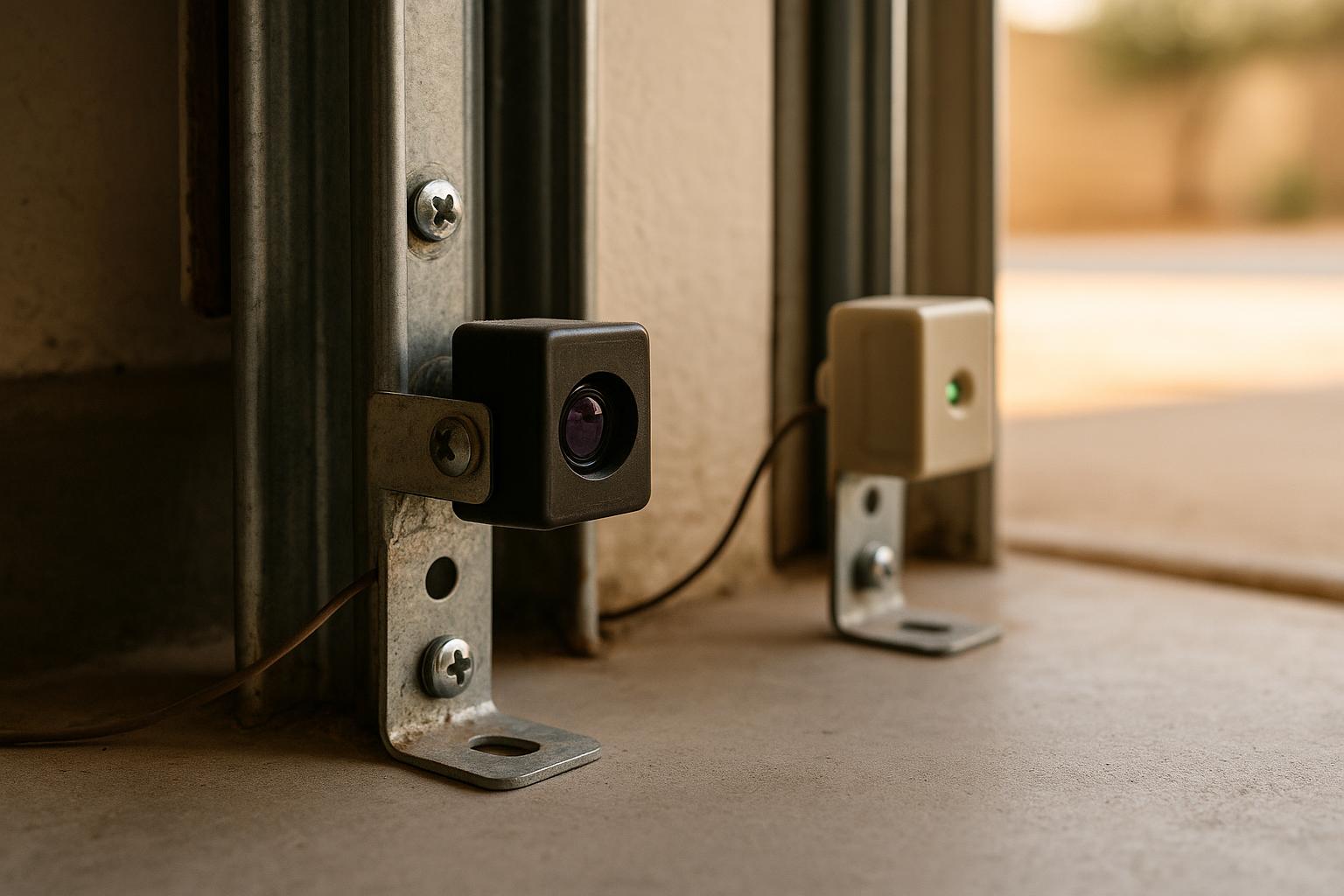
Every garage door opener manufactured after 1993 is required by federal law to have photo-eye safety sensors. These are the two small devices mounted near the bottom of your garage door tracks, about six inches off the ground. One sends an infrared beam to the other. If anything breaks that beam — a child, a pet, a trash can — the door automatically reverses to prevent injury.
Here's the problem: these sensors are sensitive. Over time, they can become misaligned from a bump, vibration, or even the settling of your garage floor. When the sensors can't "see" each other, your opener thinks there's an obstruction and reverses the door every time.
What to check:
- Look at the LED lights on each sensor. Typically, one should glow steady green and the other steady amber or orange. If either light is blinking, the sensors are misaligned or malfunctioning.
- Clean the lenses. Dust, cobwebs, and grime build up fast here in Casa Grande, especially during monsoon season. A soft cloth can make all the difference.
- Check the alignment. Gently adjust the sensors so they point directly at each other. Tighten the wing nuts or brackets once the lights are steady.
- Inspect the wiring. Look for frayed, chewed, or disconnected wires running from the sensors to the opener unit.
2. The Close-Limit Switch Needs Adjustment
Your garage door opener has settings called limit switches that tell the motor how far the door should travel when opening and closing. If the close-limit is set incorrectly, the opener may think the door has hit an obstruction when it's actually just reaching the floor.
When this happens, the opener's built-in safety feature kicks in and reverses the door — exactly as it's designed to do. The door isn't broken; it just needs to be told where the floor actually is.
How to fix it:
Most openers have adjustment screws or dials on the motor unit labeled "down limit" or "close limit." Turning the screw in small increments (usually a quarter turn at a time) allows the door to travel a bit farther before stopping. Your owner's manual will have specific instructions for your model.
If you're not comfortable making this adjustment yourself, this is a quick fix for any professional garage door technician.
3. Worn or Damaged Rollers and Tracks
If your garage door tracks are bent, dented, or clogged with debris, the door may encounter resistance as it closes. The opener interprets that resistance as an obstruction and reverses.
Similarly, worn-out rollers can cause the door to bind or stick at certain points along the track. You might hear grinding, squealing, or popping sounds as the door moves — all signs that the hardware needs attention.
What to look for:
- Visible dents or bends in the metal tracks
- Gaps between the rollers and the track
- Rollers that are cracked, chipped, or no longer spinning freely
- Debris, dirt, or small rocks lodged in the track
Track and roller issues are common in areas like Casa Grande, Coolidge, and Eloy where dust and sand are a constant presence. Regular cleaning and lubrication go a long way toward preventing these problems.
4. Broken or Weakened Torsion Springs
Your garage door's torsion springs do the heavy lifting — literally. They counterbalance the weight of the door so the opener motor doesn't have to work as hard. When a spring weakens or breaks, the door becomes significantly heavier, and the opener may struggle to control it.
In some cases, a failing spring causes the door to descend unevenly or too quickly, triggering the opener's force sensor and causing a reversal.
Important safety note: Torsion springs are under extreme tension and can cause serious injury if handled improperly. If you suspect a spring issue — you might hear a loud bang from the garage, see a gap in the spring coil, or notice the door feels much heavier than usual — call a professional. This is not a DIY repair.
5. The Opener's Force Settings Are Off
In addition to limit switches, your opener has force settings that control how much resistance the motor will push through before reversing. If the downward force is set too low, even minor friction from weather stripping, a slightly sticky track, or temperature changes can cause the door to reverse.
This is especially relevant in Arizona. The extreme heat we experience in Casa Grande can cause metal components to expand and weather stripping to soften or stick, adding just enough resistance to trigger a reversal on a sensitive opener.
Adjusting the force setting is similar to adjusting the limit switch — small incremental changes using the screws or dials on the motor unit. But be careful: setting the force too high defeats the purpose of the safety feature. The goal is to find the right balance.
6. Damaged Weather Seal Along the Bottom
The rubber seal along the bottom of your garage door creates a barrier against dust, water, insects, and heat. Over time, this seal can warp, tear, or become sticky — particularly in our desert climate where temperatures regularly exceed 110°F in summer.
A damaged or sticky weather seal can create enough drag to make the opener think something is blocking the door. Replacing the bottom seal is an affordable fix that also improves your garage's energy efficiency and keeps scorpions and other pests out.
When to Call a Professional
Some of these fixes are simple enough for a handy homeowner to tackle. Cleaning sensors, tightening brackets, and clearing debris from tracks are all reasonable DIY tasks. But if you've tried the basics and your door is still reversing, or if you suspect spring damage, track misalignment, or opener motor issues, it's time to call in a pro.
At Casa Grande Garage Door Service, we diagnose reversing doors every week. Most of the time, we can identify and fix the problem in a single visit. We serve homeowners and businesses throughout Casa Grande, Maricopa, Florence, Arizona City, and the surrounding communities.
Don't Leave Your Garage Open to the Elements
A garage door that won't close isn't just an inconvenience — it's a security risk and an invitation for heat, dust, and pests to take over your garage. The longer you leave it, the worse the underlying problem can get.
If your garage door keeps reversing and you can't figure out why, give us a call. We'll show up on time, explain exactly what's going on, and get your door working the way it should — no surprises and no runaround.